
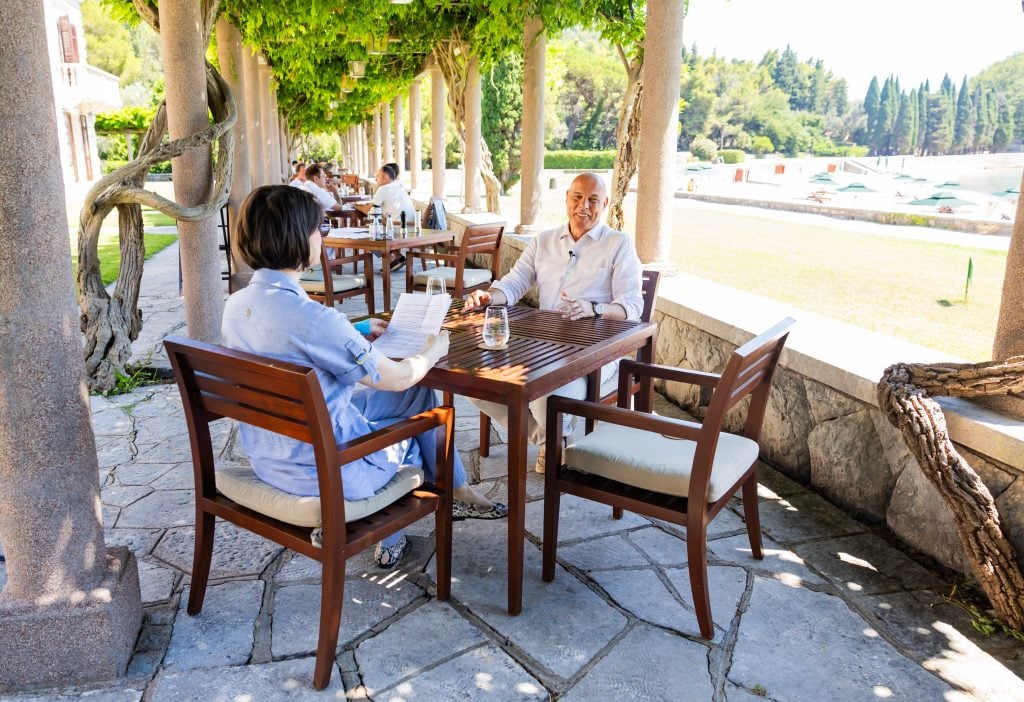


Major investments rarely come to a halt because of a lack of capital; more often, they falter when trust disappears. The reopening of Sveti Stefan after five years is therefore more than a hotel industry story, it is a test of Montenegro’s ability to reconcile the public interest, private capital and the value of a space that belongs to everyone. In an exclusive interview with Bankar, Petros Stathis, founder of Monterock International, discusses disputes, compromises and a renewed wave of investment, from Miločer and Durmitor to Nammos. His message is simple, yet demanding: luxury can generate development only where common sense becomes a lasting business policy.
Bankar: Sveti Stefan reopened on 1 July, and early reports indicate strong interest from guests. It is clear that the brand has endured. After a five-season hiatus, did you expect such a positive response?
Stathis: Of course I expected this level of interest. I know the value of this location and this project, which I fell in love with the very first time I set foot on the island. In fact, it was the final year in which the property was operated by Budvanska Rivijera. Although the entire place was in very poor condition at the time, I fell in love with it and was captivated by the location. To be honest, I did not expect that I would one day become part of this investment. However, something unexpected always happens, and that is exactly what happened to me. I initially became involved as a passive investor, but over the years I assumed full responsibility for the project. Yes, as soon as we announced that the resort would reopen, I expected interest to be extremely high. I am happy because the magic of this place is still very much alive.
Bankar: The tourism potential of Sveti Stefan has never been in question. Reaching an agreement between the two sides, however, proved considerably more difficult. You agreed with the Government that the state would receive ten per cent of the annual profit. Do you believe this cooperation model can succeed?
Stathis: First of all, I do not think that the decisive factor was the ten per cent or anything of that nature. I believe common sense ultimately prevailed. There was an international investor working with one of the finest, if not the finest, hotel brands in the world. They had been operating here for many years. We invested a great deal of money, and then found ourselves in the middle of a dispute that was more political than economic or commercial in nature. We found ourselves caught in the middle of it all, particularly me and our company, Adriatic Properties. It was the only company that genuinely suffered damage as a result of the dispute. We still have the best operator, and that is entirely clear. The operator maintained that it could not conduct business unless the contractual obligations agreed upon and signed long before were fulfilled. On the other hand, there were claims that the contract had been flawed from the moment it was signed, along with other similar objections. Ultimately, we became involved in a dispute and initiated arbitration proceedings, spending enormous amounts on legal costs.
Nevertheless, what needed to happen eventually did happen: common sense prevailed. We sat down together, considered what both sides stood to lose and decided to return this extraordinary property to the global market.
This is not important only for Adriatic Properties. It is not important only for Petros, nor only for the local community. It is important for everyone in Montenegro and for the entire world. This is a unique location. I love it, I still love it, and I hope we will continue to achieve success here for many years to come.
Bankar: Sveti Stefan is a symbol of luxury, but it is also a place to which many citizens feel deeply connected. How can the privacy of hotel guests be protected while respecting the public’s right to access and enjoy the coastline?
Stathis: From the very beginning, we sought to maintain good communication with the local community. We provided access to the churches and the beach. We did everything possible to ensure that people understood that we were not some cold, faceless investor who had arrived to say: “This is ours now, and you no longer have any rights.” On the contrary, we increasingly supported that relationship. We gave priority to local residents in recruitment. We provided access and waived certain rights to which we were entitled under the existing contract, which is very important to emphasise. I did not sign that contract, and the investment was not mine when the contract was concluded. We inherited an agreement that had already been prepared. We sought to fulfil all the obligations it imposed on us. We faced various challenges. You are familiar with the stories concerning Block 25, the church and the remains that were discovered. We did everything we could to demonstrate respect.


I personally provided the funds required to restore the church to its original form. I always try to speak with local residents and explain that we have leased this place and that it does not belong to me. It belongs to the citizens of Montenegro. We have leased it and are investing money to restore it to its former glory.
I believe we succeeded in doing so. Think back to the first years of operation and the number of articles published in magazines around the world, the promotional coverage, and the celebrities and prominent members of the international business community who came here. I can mention one person whom I met here: Mr Bill Gates. People of that calibre visit this place, congratulate us on what we are doing and, naturally, speak highly of a country that decided to bring the finest brand to its finest location. I believe there is a great deal of misunderstanding surrounding this issue. As far as Queen’s Beach is concerned, it has always been private. It did not become private only during the past ten years of our management. That is why the reaction surprised me, particularly because we had tried to send a strong message that our primary objective was to preserve the area. At Queen’s Beach, we had the right to construct a new hotel. Instead, we developed an attractive spa centre, which does not generate particularly high revenue for our investment, precisely because we wanted to preserve the site. The same approach can be seen on the island, where every detail was treated as an element of the property’s cultural heritage. We had to remove stones, mark each individual stone with a number and then return it to exactly the same place. That is the value we preserved and protected. For all these reasons, we expect our efforts to be appreciated and, at the very least, to receive the support of the local community.
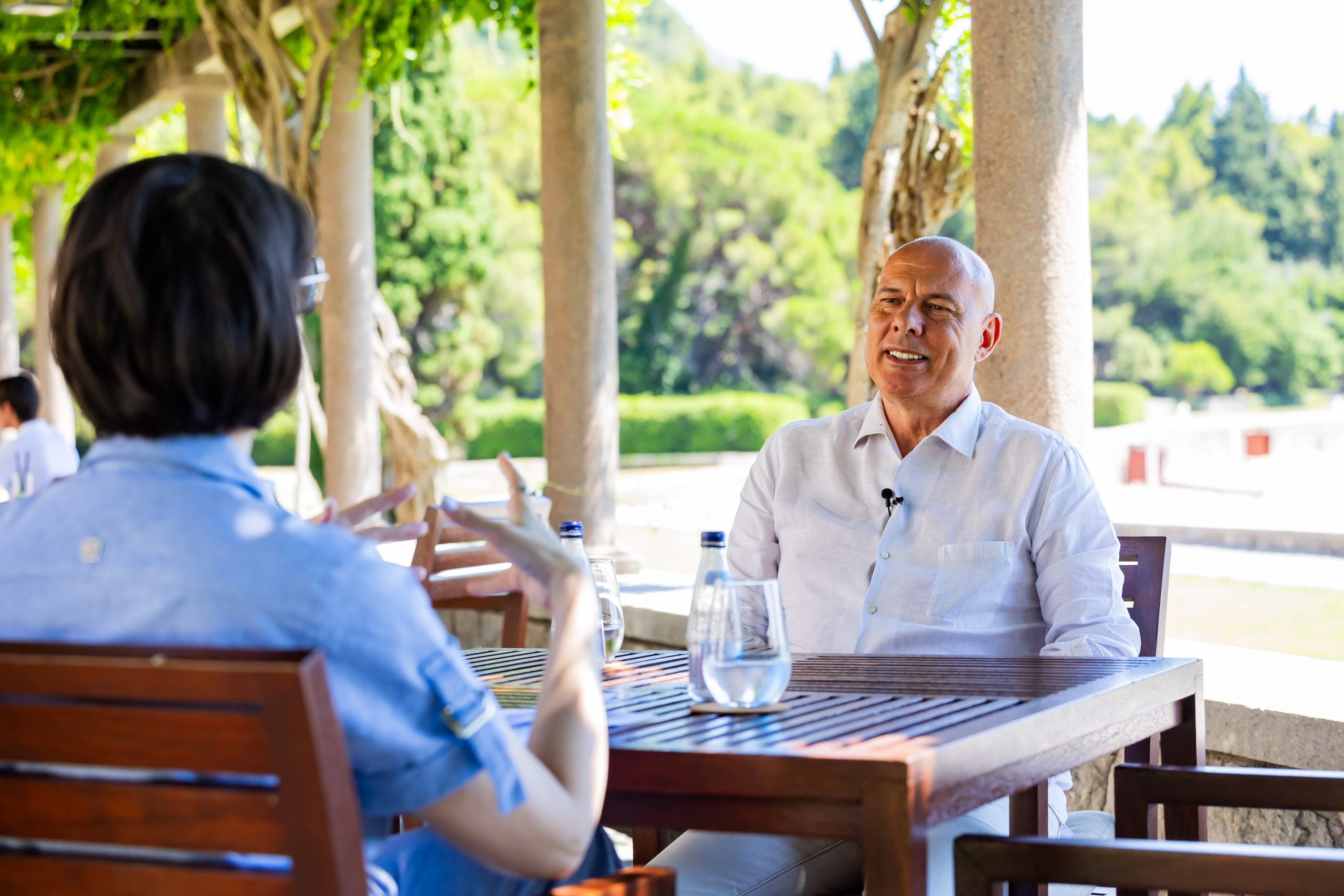
Bankar: When speaking with international investors, how do you present Sveti Stefan today, as a problem that has been resolved, or as evidence that Montenegro is becoming a safer and more reliable investment destination?
Stathis: I can say that Montenegro is making major strides towards the European Union. A number of European leaders have recently visited the country, including our Greek prime minister, and the strong support enjoyed by Montenegro was clearly evident. I believe there is a great deal of confidence in the country, which is why the process has reached such an advanced stage.
I continue to convey the same message. I have never changed my attitude towards Montenegro. It is a beautiful Balkan country. I am also from the Balkans, as you know. As people from the Balkans, we have our ups and downs, that is part of our character. Nevertheless, I genuinely feel very optimistic. This is something positive and beneficial for everyone.
We invested our own money and, naturally, planned for that investment to generate a return one day. However, we did not undertake this project merely so that we could say we had done it. We love this place, and we invested a great deal of love in achieving the result you see today.
Bankar: The Government has stated that there will be no new construction in Miločer Park beyond what is covered by permits that have already been issued. Could the greatest value of this area lie precisely in preserving what already exists and managing it more effectively?
Stathis: The principal feature of this beautiful park is its landscape. Even after five years during which the hotel was not operating, you can see that everything has remained as it was before. Throughout that period, we maintained the property to the highest possible standard. We will fully honour everything that was signed and agreed upon between the parties. We have also agreed to provide the local community and the public with broader access to the area. I believe that is a good formula. I think we have now found the right solution. Naturally, I am somewhat apprehensive and uncertain, because there is always the possibility of another unexpected development. Nevertheless, I sincerely hope for only one thing, that common sense will prevail. I am not asking for anything special, nor am I asking for any favours. I simply want people to understand what is happening here.

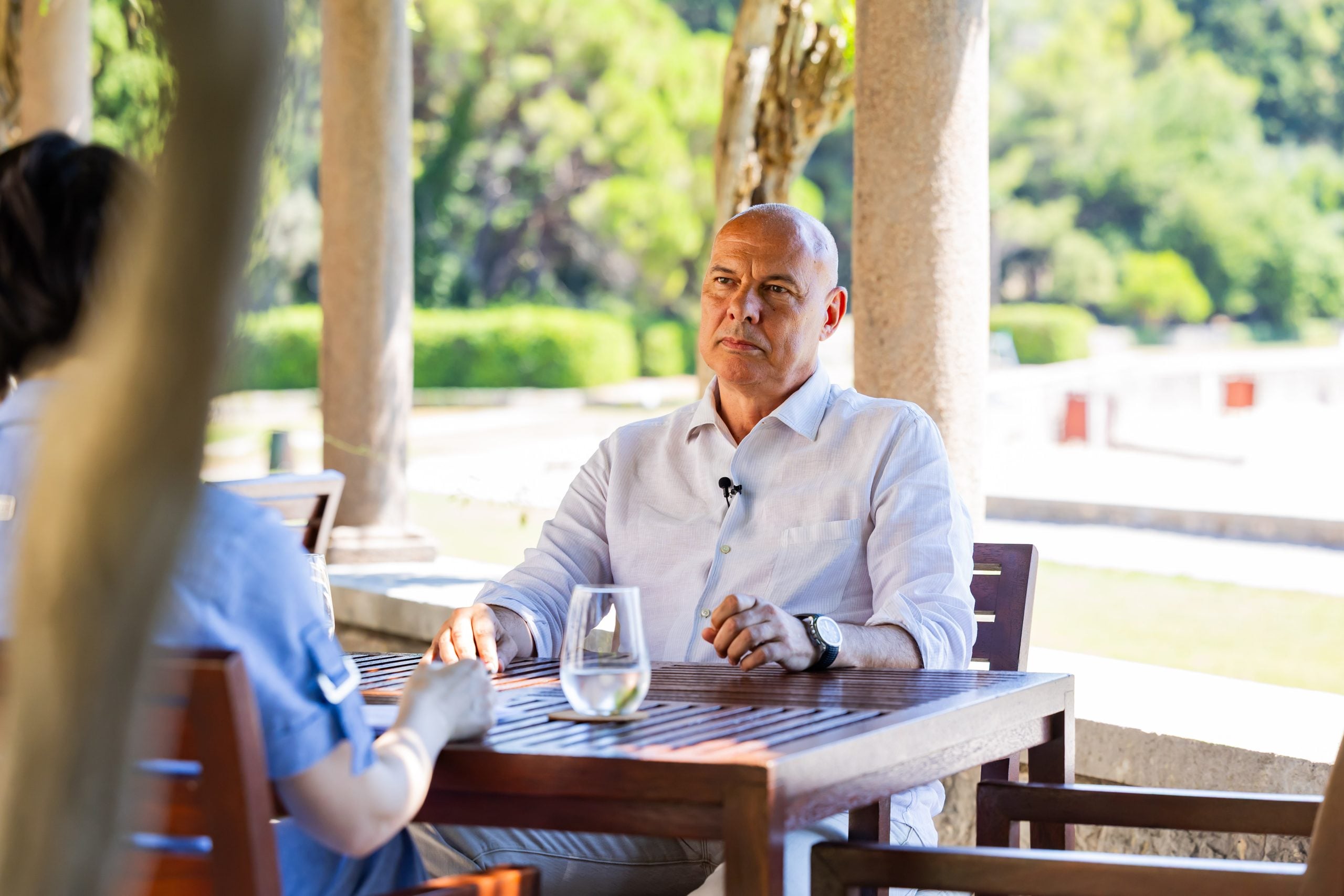
Bankar: Looking five years ahead, what would you consider the greatest success: Sveti Stefan becoming the most expensive hotel on the Adriatic, the most desirable destination in the Mediterranean, or proof that Montenegro can successfully implement major investments without conflict?
Stathis: As you know, I am also an investor in other Aman hotels situated in unique locations. One of them is the hotel in Venice, which is achieving exceptional results. As an operator, Aman has the privilege of being selected for some of the finest locations in the world. You are familiar with the story of Aman in Beijing, next to the Summer Palace, where the Chinese Government entrusted Aman with the management of that beautiful location. The new Aman in Bangkok is also situated within a protected area. Everything begins with the respect that Aman commands. Returning to this particular location, we attract people who understand that we can make a difference here. Look at the surroundings behind me. Everything here makes an enormous difference. The location is extraordinary, and the country is beautiful. Montenegro’s wild beauty is an exceptional story. More and more people are coming, experiencing that beauty and discovering it personally. Word of mouth is more powerful than anything else. People return to their countries and speak about the uniqueness of this place. As a result, we are seeing interest from an increasing number of visitors.
Bankar: The Hotel Durmitor project is once again in the public spotlight. There has been discussion about the continuation of construction, cooperation with Aman and the involvement of Novak Djokovic. Can you tell us clearly whether the financing, deadlines and management plan have now been defined, or whether the project still depends on unresolved matters concerning Sveti Stefan?
Stathis: For us, this is a new beginning. Not even two months have passed since we reached the basic agreement. Durmitor is also part of that plan, because we are speaking about the same operator. The operator there is expected to be Janu by Aman. It is true that Novak Djokovic is a legend and a man who loves Montenegro. He loves this place as well and, as you know, he was married here. I can tell you that he may love Durmitor even more. He loves the nature there and feels that it gives him positive energy. I was very pleased when we spoke and when he expressed an interest in becoming our partner in that project. It is only a matter of time before we announce all the details. We are currently reviewing every element of the project: its development, costs, deadlines and all other particulars. We will make a major announcement very soon. Believe me, both you and the Montenegrin public will be pleased with our plans.
Bankar: At this year’s RE:D conference, we heard that Montenegro could become one of the best countries in the world both in which to live and to invest. What role could Sveti Stefan, Miločer and Hotel Durmitor in Žabljak play in achieving that vision?
Stathis: I have to say something, although I do not want to sound egotistical. One of the reasons all those people came to Montenegro and decided to invest in the country was the opening of Aman Sveti Stefan. I can tell you that investors from Azerbaijan also stayed here. They discovered the property, fell in love with it and were among the first to express an interest in becoming our partners. After we told them there was no opportunity for a partnership, they developed Portonovi, which is now an exceptional destination. Many people associated with the Porto Montenegro project, including its former owners, Peter Munk and his partners, as well as the new owner, ICD, the state investment fund from Dubai, were Aman guests first. They came to see Aman and then discovered the beauty of the Montenegrin coast.Even representatives of the Qatar Investment Authority, QIA, visited Aman Sveti Stefan first when they came to Montenegro, after which they wanted to develop a project of their own. The same applies to Luštica; they had all previously visited this property. I can tell you that members of the Sawiris family stayed here with me at the very beginning, the father and the sons. They fell in love with the place. I believe we have made a major contribution to Montenegro’s development. I would also like to congratulate you on the conferences you organise, because you succeed in attracting highly influential individuals, such as Mr Al Shaibani and His Excellency Mr Alabbar. I live in Dubai, and I know very well how highly respected these individuals are and the successful business stories behind them. In my view, their interest represents one of the greatest assets Montenegro can gain at this moment.
Bankar: I cannot miss the opportunity to ask you about the Nammos Resort project, a new luxury destination. The agreement has been signed. What will this project bring to Montenegro?
Stathis: Nammos is another project representing a five-star lifestyle. It is something unique. I became an investor in Nammos after investing in Sveti Stefan. I decided to take that step after my family moved to Dubai, because I wanted to establish certain business activities there as well. My first idea was to open an Aman hotel in Dubai. However, a project of that kind would not have made the same degree of difference there in terms of that particular type of quality. Unfortunately, Dubai does not have as much historical heritage on which to draw. Everything there has to be created from the ground up. I realised that the food, beverage and hospitality sector was extremely successful. I am very pleased that, after we brought Nammos to Dubai, the restaurant generated the highest revenue of any individual restaurant in the world—USD 70 million. Everyone was surprised. Even Their Highnesses in Dubai were surprised. This led to enormous growth for the brand. Nammos had been very successful in Mykonos, but only up to a certain level. By expanding into Dubai, it became a global brand.
We commissioned research showing that Nammos was the most recognisable Greek brand in the world after Metaxa. As a Greek, the fact that I contributed to that achievement makes me extremely proud. As soon as the conditions were created for reopening here, my natural reaction was to say that we had to bring the Nammos brand to Montenegro. We also brought Zuma, which forms part of our business activities with partners from Abu Dhabi. I remember the first board meeting with Azumi, the company behind the Zuma brand. When I mentioned Montenegro, their response was: “Really?”
I have to say that they are now very pleased, and I am also happy that they are here. Their presence adds value not only to this location, but to Montenegro as a whole. Zuma also opens its restaurants in highly recognisable and iconic locations. Its arrival here represents a major advantage.
Bankar: After everything that has happened, can we expect further investments and projects from you in Montenegro in the coming years?
Stathis: It is true that there have been certain challenges, but I am a businessman. We now have a major partnership with the leadership of Abu Dhabi, and our portfolio includes a large number of brands. Anything that makes business sense and is aligned with our projects and growth plans, we will be pleased to bring to Montenegro. I genuinely believe in Montenegro’s future. I hope that all the announced plans will be implemented, beginning with the privatisation of the airports. We must improve the country’s transport connectivity. I meet clients who have only just arrived and who experienced difficulties finding suitable flights and connections.
Should Montenegro implement the plans I have heard about, even more brands will come. Believe me, all the major names are already waiting for their opportunity. We should continue what we are doing and direct the attention of the Montenegrin public towards these brands and investors. People such as Mr Alabbar, Mr Al Shaibani, members of the Sawiris family and others who come to this country generate added value.
It is not only about expensive brands. They bring workers, clients and people who purchase domestic products.That is precisely the kind of business community we need. Look at how Dubai began. It attracted all those people and became what it is today. Dubai has become part of my family’s life and has been my home for the past twelve years. I have never regretted that decision.
Ivana Boljević