
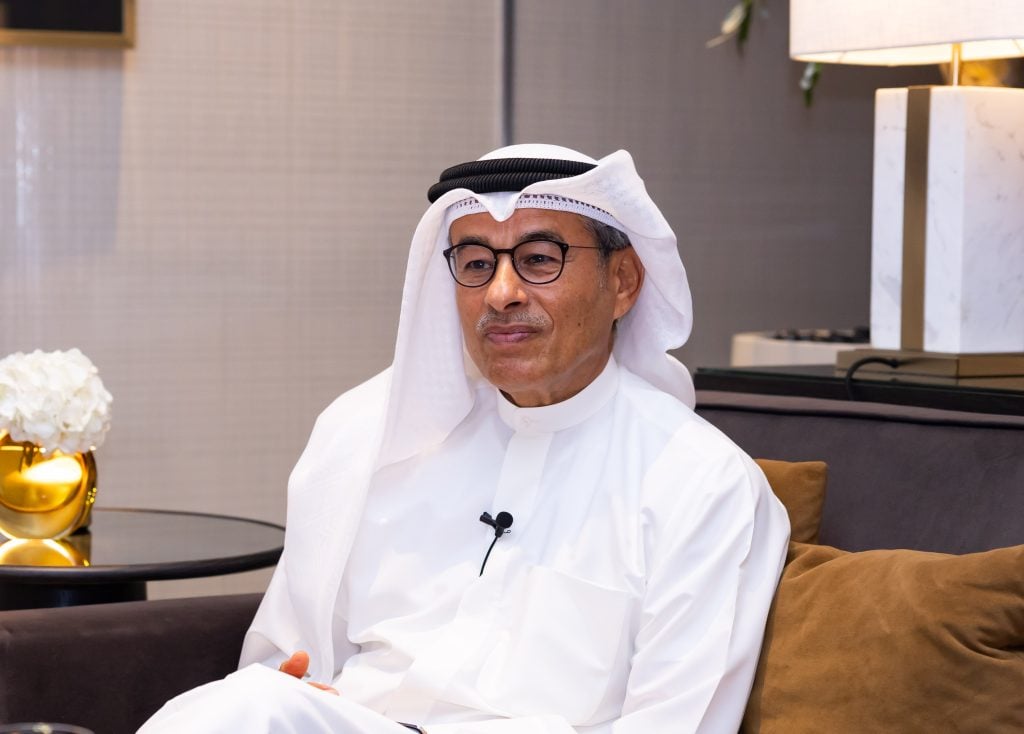


Emaar and Noon founder and Eagle Hills Chairman Mohamed Alabbar said his team was ready to buy distressed projects after the regional crisis broke out earlier this year. However, no such opportunity appeared — which, according to him, best demonstrates the resilience of Dubai’s real estate market.
Mohamed Alabbar, founder of Emaar and Noon and Chairman of Eagle Hills, said his team had set aside AED 5 billion, around EUR 1.16 billion, to purchase distressed real estate projects in Dubai following the outbreak of the U.S.-Iran-Israel conflict earlier this year.
However, he said they were unable to find a single suitable project to acquire. Alabbar claims this is the best proof of the maturity and resilience of Dubai’s real estate market, as well as the confidence investors continue to have in the emirate.
Speaking at the 11th Emirati Media Forum, Alabbar said one of the UAE’s greatest economic strengths is the culture of stability and trust that, as he noted, has been built by the country’s leadership, Investitor reports.
“We allocated AED 5 billion to buy distressed projects and did not find a single one,” Alabbar said, according to Al Khaleej, as cited by Gulf News.
Dubai continues to attract long-term capital


His comments come at a time when public debate continues over the sustainability of the strong growth in prices and activity in Dubai’s real estate market. In recent years, that growth has been driven by a strong influx of residents, foreign capital and high demand from international buyers.
Alabbar believes the market is not based on short-term euphoria, but on real liquidity, long-term capital and a developed regulatory framework. In his view, this is precisely what gives Dubai greater resilience to global economic and geopolitical shocks.
He also said developers continued to plan major investments even during periods of heightened uncertainty. As an example, he mentioned a project worth AED 200 billion, which, according to him, was conceived under wartime conditions.
Sales slowed, but did not stop

Alabbar said sales in some projects had reached around AED 500 million per day before the latest regional tensions. During the period of heightened uncertainty, that amount fell to around AED 150 million per day.
Still, in his view, even that level of sales shows that demand has not disappeared and that investors have not lost confidence in the UAE market.
He cited activity in shopping malls, airport traffic and the continuation of major investment projects as further indicators of the economy’s strength.
Dubai and the UAE, he said, have positioned themselves as a stable business environment and a safe investment destination, regardless of regional and global challenges.
Less race for height, more quality of life
Speaking about the period ahead, Alabbar said he expects the UAE real estate market to remain orderly in 2027.
According to him, the future development of the real estate sector will not be based only on record-breaking building heights or the size of projects, but increasingly on quality of life, innovation and integrated urban experiences.
Alabbar also confirmed that Dubai Creek Tower remains part of the group’s long-term plans, but that its launch will depend on market conditions, project costs and an assessment of the best timing for implementation.