


Three companies managing Montenegro’s leading resorts – Luštica, Porto Montenegro, and Porto Novi – recorded revenue and asset growth in 2025, but with significantly different trends in profitability, debt, and employment compared to 2024.
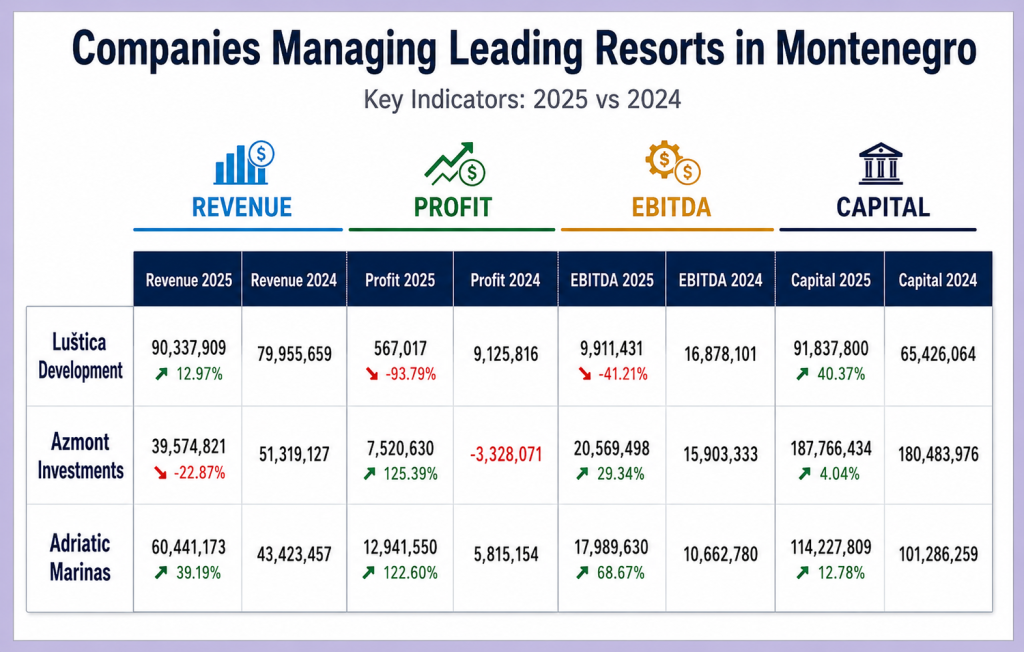
The three companies operating these resorts – Luštica Development, Adriatic Marinas, and Azmont Investments—generated approximately €190 million in revenue and more than €21 million in net profit in 2025, with total equity nearing €400 million. At the recent RE:D conference, their management teams announced new development phases, focusing on extending the tourist season, expanding capacity, and investing in amenities that enhance destination value.
Luštica Development: Revenue Growth, Profit Under Pressure
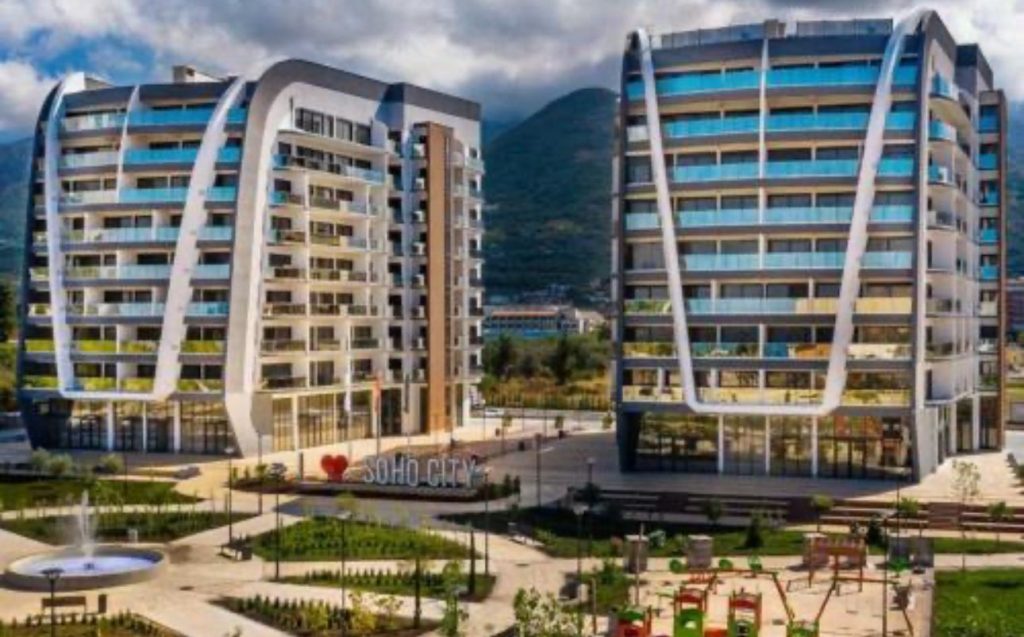
Luštica Development, the developer and operator of Luštica Bay, continued to grow revenues in 2025, but with a sharp deterioration in net results. Total revenues increased from approximately €79.96 million in 2024 to about €90.34 million in 2025 (around 12% growth), while total expenses rose from €70.39 million to €89.19 million (an increase of about 26.7%). As a result, net profit dropped from €9.13 million in 2024 to just €0.57 million in 2025—a decline of over 90%, putting significant pressure on profit margins.
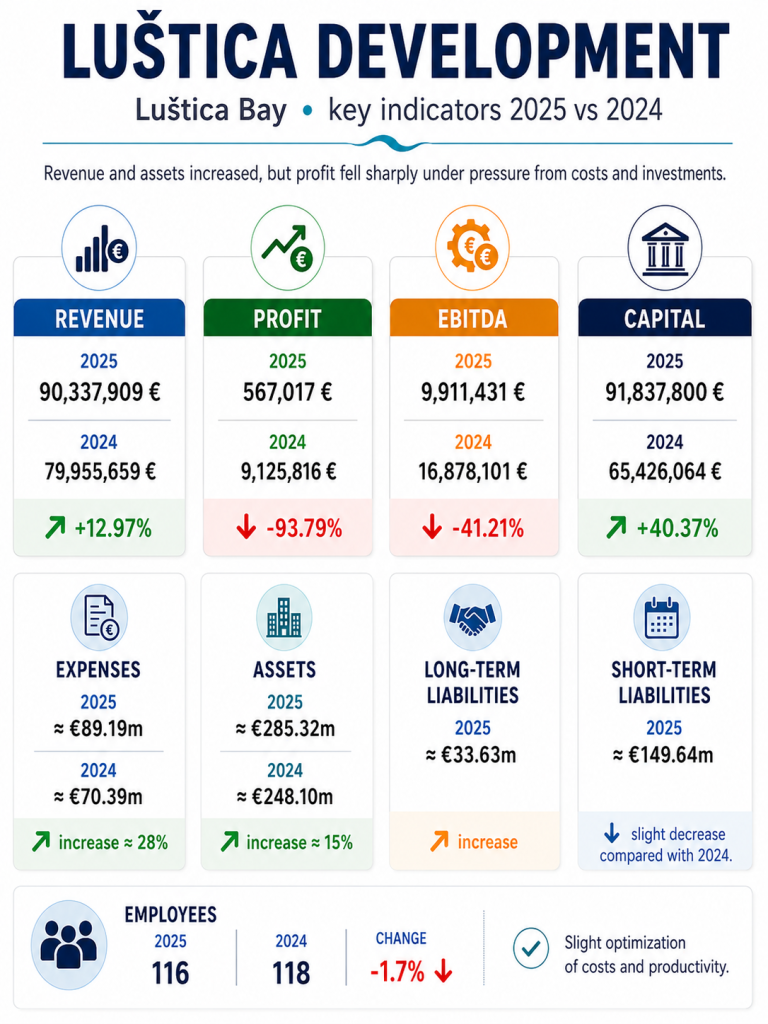
EBITDA decreased from €16.88 million to €9.91 million (down about 42%), indicating rising operating costs and intensified investment activity during the expansion phase. At the same time, total assets grew from €248.10 million to €285.32 million, driven by increases in both fixed and current assets. Equity rose from €65.43 million to €91.84 million, suggesting additional capital injections and stronger internal financing. Long-term liabilities increased to €33.63 million, while short-term liabilities slightly declined to €149.64 million. The number of employees decreased marginally from 118 to 116, following strong growth in previous years.
Management recently stated that the next development phases will include expansion of residential zones, golf facilities, and hotel capacity, with stronger focus on off-season activities. Investments will prioritize events, sports, congress, and lifestyle offerings, aiming to transform Luštica Bay into a year-round community rather than a seasonal resort.


Adriatic Marinas (Porto Montenegro): Record Revenue and Profit with Fewer Employees
Adriatic Marinas, the operator of Porto Montenegro in Tivat, achieved the most dynamic growth among the three companies in 2025. Total revenues rose from €43.42 million in 2024 to €60.44 million in 2025 (nearly 40% growth). Total expenses increased from €37.57 million to €45.89 million (around 22%), resulting in net profit more than doubling—from €5.82 million in 2024 to €12.94 million in 2025.
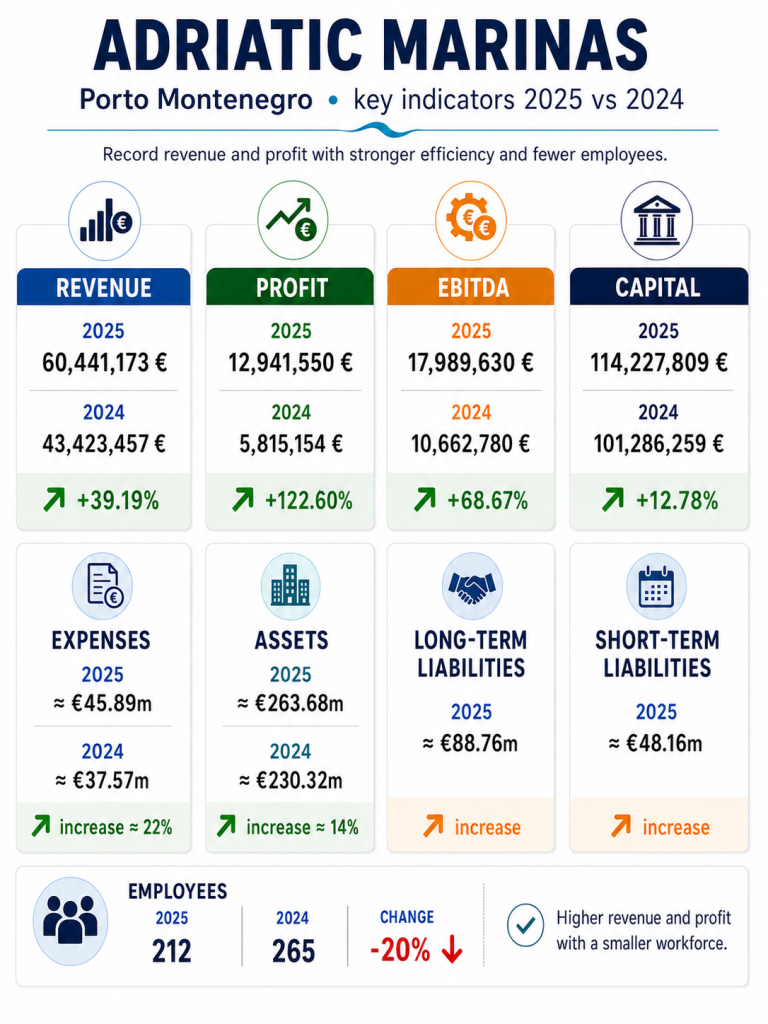
EBITDA increased from €10.66 million to €17.99 million (up about 68%), reflecting significant improvements in operational efficiency and better utilization of marina and hotel capacities. Total assets grew from €230.32 million to €263.68 million; fixed assets rose from €206.55 million to €245.16 million, while equity increased from €101.29 million to €114.23 million. Long-term liabilities reached €88.76 million, while short-term liabilities amounted to €48.16 million, reflecting both ongoing investments and higher working capital needs.
The number of employees dropped significantly—from 265 in 2024 to 212 in 2025 (a decline of around 20%). Despite this, revenue and profit growth were achieved with a smaller workforce, indicating higher productivity per employee and greater reliance on seasonal labor and external contractors. Porto Montenegro’s management recently announced entry into a new development phase, including additional yacht berths, marina expansion, and further investment in the Synchro Yards area and surrounding lifestyle districts. Plans also include strengthening the shipyard and refit center, positioning Tivat as a key year-round superyacht hub in the Mediterranean, thereby extending the season and increasing revenue per guest.

Azmont Investments (Porto Novi): Revenue Decline, Strong Profit Growth and Deleveraging
Azmont Investments, the investor and operator of Porto Novi in Herceg Novi, recorded a turnaround from loss to solid profitability in 2025, despite lower revenues and significant changes in its liability structure. Total revenues declined from €51.32 million in 2024 to €39.57 million in 2025 (down about 23%). At the same time, total expenses dropped from €54.65 million to €32.05 million (a decrease of about 42%), resulting in a shift from a €3.33 million loss in 2024 to a €7.52 million profit in 2025.
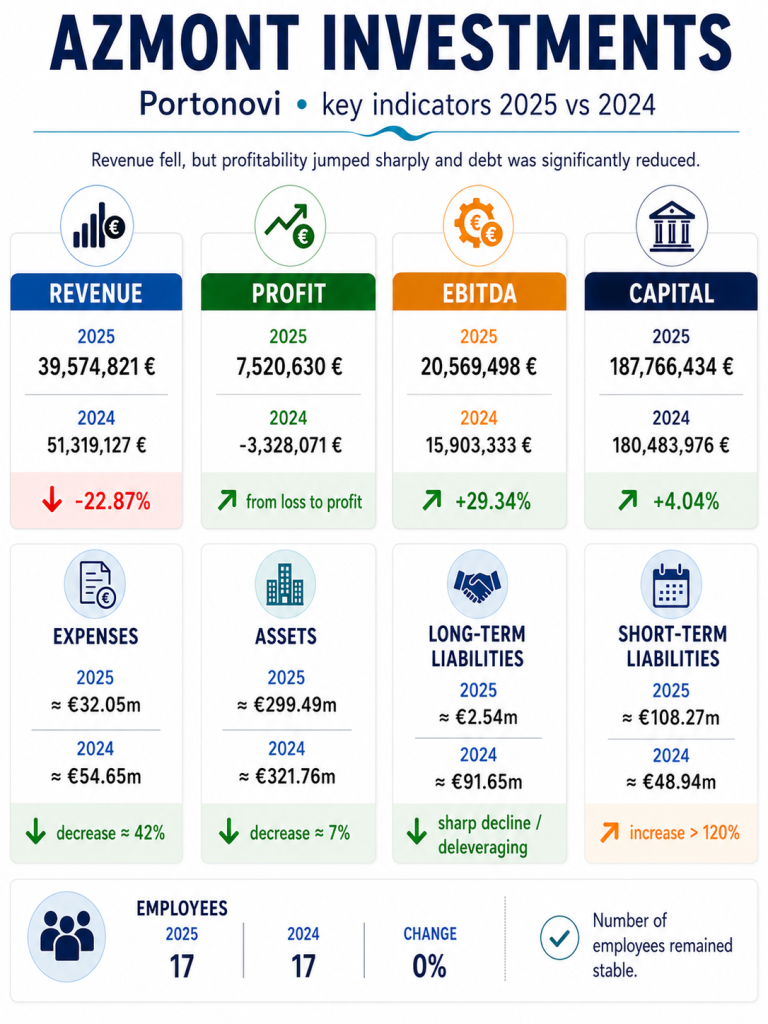
EBITDA increased from €15.90 million to €20.57 million (up around 29%), indicating stabilization of the operating model following a period of intensive investment. Total assets decreased from €321.76 million to €299.49 million, while current assets declined more significantly, possibly reflecting asset monetization or reductions in inventories and receivables. Equity rose slightly to €187.77 million.
The most significant changes occurred in liabilities: long-term liabilities were almost eliminated, dropping from €91.65 million to €2.54 million, indicating strong deleveraging, refinancing, or debt conversion. In contrast, short-term liabilities increased from €48.94 million to €108.27 million (over 120% growth), shifting part of the burden to the short-term horizon and potentially increasing refinancing needs. The number of employees remained stable at 17.
Porto Novi management recently announced consideration of further development phases, including new residential units and additional hotel and wellness facilities. Plans include strengthening the One&Only complex and extending the season through year-round events and an expanded offering, aiming to increase guest stays and spending beyond the summer months.
The Next Investment Wave
A common thread across all three projects is the growing importance of luxury tourism and residential developments in Montenegro’s economic structure. Porto Montenegro demonstrates how a mature project can generate high profitability with optimized employment; Luštica Bay illustrates how, during intensive expansion, revenue growth is often offset by rising costs and investments; Porto Novi shows how transitioning from construction to operational phase, combined with deleveraging, can significantly improve results even with lower revenues.
Announcements from the recent RE:D conference point toward new investment cycles: marina and refit capacity expansion in Tivat, further residential and hotel development phases in Luštica and Porto Novi, and strengthening of year-round destination offerings. For the state and financial sector, this signals continued strong inflows of foreign currency and tax revenues.
Ž. Radulović